
Date 30 Mar 2026
If your breasts feel persistently heavy and start affecting your posture, comfort, or daily life, it may be time to consider medical evaluation. When non-surgical methods like posture correction, physiotherapy, or supportive garments no longer provide relief, surgical options can be explored. Breast reduction surgery becomes a valid consideration when symptoms move from occasional discomfort to chronic physical or emotional strain.
Heavy breasts are medically associated with conditions such as macromastia or breast hypertrophy, where the breast tissue is disproportionately large relative to the individual’s body frame.
The key issue is not just volume, but the way that weight is distributed across the upper body. The breast mass creates a continuous forward pull, which shifts the body’s center of gravity. To maintain balance, the spine and surrounding muscles compensate, often in ways that are not biomechanically ideal.
Over time, this leads to:
Increased load on the cervical and thoracic spine
Continuous activation of upper back and neck muscles
Progressive postural changes
What begins as a minor adjustment gradually becomes a sustained strain, affecting both comfort and function.
If you’re still trying to understand what your body is experiencing and how similar concerns are approached, you can explore more insights.
Read the blog

The body typically adapts before it begins to show clear signs of distress. However, when compensation is no longer sufficient, symptoms become more noticeable and persistent.
Many individuals report ongoing discomfort that becomes part of their daily routine rather than an occasional issue. Common signs include:
Chronic pain in the neck, shoulders, or upper back
Shoulder indentations from bra straps due to sustained pressure
Difficulty maintaining upright posture for long periods
Rounded shoulders or forward head posture
In addition to musculoskeletal strain, local skin and nerve-related symptoms may develop due to constant pressure and friction:
Skin irritation or rashes under the breast fold (intertrigo)
Moisture accumulation leading to fungal infections
Tingling or numbness in the arms due to nerve compression
As the condition progresses, it starts interfering with routine activities:
Reduced ability to exercise or engage in physical activity
Discomfort while sitting, standing, or walking for extended periods
Occasional breathlessness in severe cases
These symptoms indicate that the body is under continuous mechanical stress and is no longer able to compensate effectively.
The underlying cause of these symptoms is mechanical overload. The additional weight of the breasts alters the alignment of the upper body, forcing muscles and ligaments to work harder to maintain balance.
This results in:
Muscle fatigue and overuse, particularly in the upper back
Postural imbalance, which becomes habitual over time
Ligament strain, affecting spinal support
Nerve compression, leading to sensory symptoms
If left unaddressed, these changes can contribute to long-term conditions such as chronic back pain or postural deformities. The longer the mechanical imbalance persists, the more difficult it becomes to correct through non-surgical means.
Breast reduction surgery, medically termed reduction mammoplasty, is a surgical procedure performed to decrease breast volume by removing excess glandular tissue, adipose (fat) tissue, and redundant skin.
The primary objective of the procedure is to reduce the weight of the breasts, improve body proportion, and relieve symptoms associated with breast hypertrophy, such as musculoskeletal strain and postural imbalance. In addition to volume reduction, the surgery also focuses on reshaping the breast to achieve a stable and functional contour.
Breast reduction surgery is designed to remove excess breast tissue, fat, and skin while reshaping the breast to achieve proportion and balance.
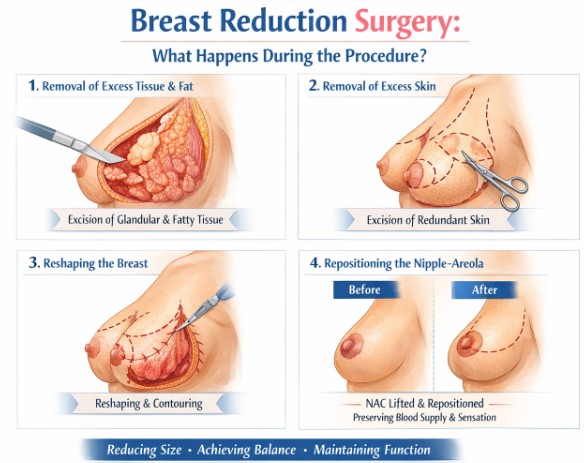
The procedure typically involves:
Excision of excess glandular tissue and adipose tissue to reduce overall breast volume
Removal of redundant skin to accommodate the reduced breast size
Reshaping (recontouring) of the remaining breast tissue to achieve a natural breast profile
Repositioning of the nipple-areola complex (NAC) to maintain anatomical alignment and proportion
Depending on the surgical technique used, the blood supply and innervation to the nipple-areola complex are preserved to maintain vascularity and sensory function.
Not every case of heavy breasts requires surgery. However, there are clear thresholds where breast reduction surgery becomes clinically justified.

1. Pain Has Become Chronic
If discomfort is no longer occasional but constant, it indicates structural stress that conservative treatments cannot fully resolve.
2. Conservative Methods No Longer Help
If physiotherapy, posture correction, weight loss, or supportive bras have failed, the underlying issue may require surgical correction.
3. Daily Function Is Affected
When routine activities like walking, exercising, or even sleeping are impacted by large breast problems, it becomes a functional limitation rather than a preference.
4. Emotional and Psychological Strain
The physical burden often extends into emotional discomfort, restricted clothing choices, self-consciousness, and social withdrawal can all play a role.
If you're beginning to consider whether this could be the right solution for you, it helps to understand how the procedure is designed and who it is best suited for.
Explore our services
The breast reduction cost cannot be defined as a fixed number because it varies based on several clinical and operational factors. Each case is different in terms of anatomy, surgical complexity, and treatment approach, which directly influences the overall cost.
Key factors include:
Surgeon’s expertise and experience
Hospital or surgical facility
Complexity of the case
Geographic location
In India, the breast reduction cost can vary widely across different healthcare settings. While cost is an important consideration, it should not be the primary deciding factor. Surgical safety, adherence to clinical protocols, and the surgeon’s ability to deliver consistent functional and aesthetic outcomes are significantly more important for long-term results.
Since every individual’s requirement is different, the most accurate way to understand your treatment plan and cost is through a consultation. Book Now
Before considering surgery, most individuals try to manage large breast-related discomfort using conservative, non-invasive approaches that aim to reduce strain rather than change breast volume.
These commonly include:
High-support or medically fitted bras, which help redistribute breast weight and reduce pressure on the shoulders and upper back
Strength training and posture correction exercises, aimed at improving muscle support around the spine and reducing postural imbalance
Weight management, which may slightly reduce fatty breast tissue in some individuals but does not significantly impact glandular volume
Physiotherapy, focused on relieving muscle tension, improving mobility, and managing pain symptoms
While these methods can provide short-term symptom relief and improve functional comfort, they do not address the underlying cause, excess breast tissue and volume. As a result, the mechanical load on the spine and surrounding structures remains unchanged.
Breast reduction surgery can be considered when conservative measures are no longer sufficient to manage symptoms and the underlying mechanical load continues to affect the body. Ask yourself:
Is discomfort impacting your routine?
Have non-surgical methods failed?
Do you feel physically or emotionally restricted?
If the answer leans toward “yes,” a clinical consultation can help determine whether breast reduction surgery is appropriate.
If you are experiencing persistent symptoms or feel that non-surgical methods are no longer effective, it may be the right time to seek expert guidance.
Consult the specialists at Eternelle Aesthetics to get a detailed clinical assessment, understand your options, and explore a safe, well-planned approach to breast reduction surgery tailored to your needs.
Yes, prolonged strain from heavy breasts can gradually affect spinal alignment, leading to conditions like kyphosis, muscle imbalance, and chronic back pain if the underlying cause is not addressed early.
Breast reduction surgery usually preserves sensation, but temporary numbness or sensitivity changes can occur. Modern surgical techniques focus on protecting nerve pathways to minimize long-term sensory impact.
There is no strict age, but breast reduction surgery is typically considered after full breast development, especially when symptoms from large breast problems are persistent and affect physical comfort or daily functioning.
In certain cases, the breast reduction cost may be partially or fully covered if large breast problems are medically documented, such as chronic pain, posture issues, or recurring skin infections.
After breast reduction surgery, significant regrowth is uncommon, but factors like hormonal changes, pregnancy, or weight gain can influence breast size and potentially lead to some increase over time.