
Date 27 May 2026
Medically Reviewed By Dr. Deepthi Devarakonda — MS Gen Surgery, MCh Plastic Surgery, Consultant Plastic Surgeon
|
Hair loss is often spoken about as a men's concern, but now a days a growing number of women are also complaining about hair thinning, widening partitions, receding hairlines, and patchy baldness at a much younger age than before.
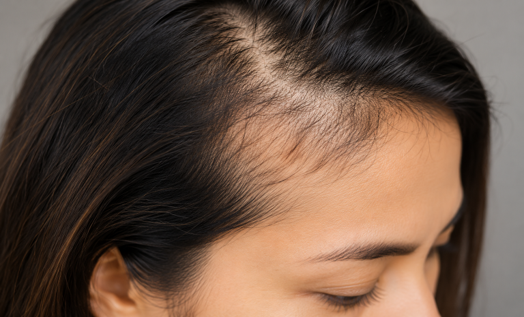
In most conditions, hair fall is caused by stress, nutrition deficiencies, hormonal imbalance, or medical reasons which can be effectively managed with medication and lifestyle correction. But a large number of women in India are experiencing permanent hair thinning that does not improve with conventional treatments.
Hair transplant for women in India is becoming increasingly popular because of advancements in medical technology, precision techniques, and natural-looking outcomes. Women who once believed they had to permanently live with thinning hair are now exploring long-term restoration solutions that are safer and more sophisticated than ever before.
But, "Is hair transplant safe for women?" The answer depends on several factors, including the type of hair loss, scalp condition, overall health, and the expertise of the clinic performing the procedure. In this blog, we'll understand these aspects to help you make an informed decision.
Female hair loss is very different from male pattern baldness. Men often develop clear bald patches or receding hairlines, while women usually experience diffuse thinning across the scalp. The hair density gradually decreases, making the scalp more visible over time.
In many women, the follicles do not completely disappear initially. Instead, they gradually miniaturize. The hair strands become thinner, weaker, and shorter over time until the follicles eventually stop producing visible hair.
This stage is extremely important because not all women immediately require surgery. Many patients benefit from early-stage female hair loss treatment options such as PRP therapy, GFC therapy, hormonal correction, nutritional management, or regenerative scalp treatments before transplantation is considered.
A female hair transplant is a cosmetic surgical procedure where healthy hair follicles are extracted from donor areas, usually from the back or sides of the scalp, and implanted into thinning or bald regions.
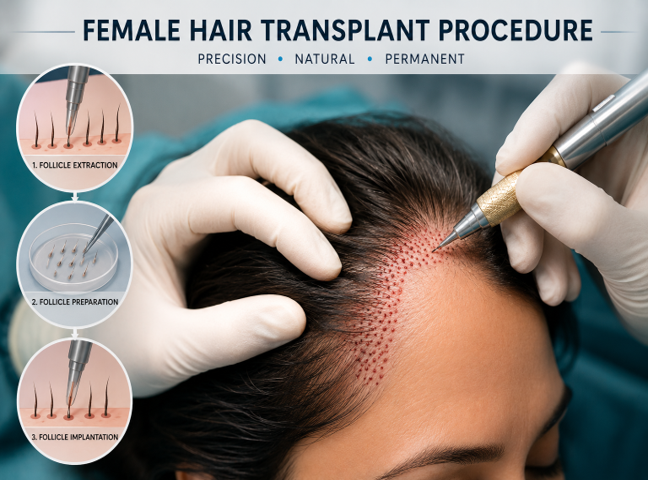
The donor area is usually located at the back or sides of the scalp because these follicles are typically more resistant to hormonal hair loss.
Modern hair transplant for women in India commonly involves highly advanced microscopic implantation techniques.
In this technique, individual hair follicles are extracted one by one and implanted into thinning areas. It leaves minimal scarring and offers faster recovery. Advanced FUE systems now use ultra-microscopic extraction tools that reduce trauma to surrounding follicles.
This method involves removing a strip of scalp tissue from the donor area to harvest follicles. It may be recommended in cases requiring a larger number of grafts. Although FUT may leave a linear scar, experienced surgeons often conceal it effectively beneath surrounding hair density.
Many advanced clinics now use refined implantation tools and microscopic graft handling techniques for higher precision and more natural density. This is one reason why the hair transplant success rate in women has improved significantly in experienced centers over the past decade.
At Eternelle Aesthetics, the focus is not only on transplantation but also on creating personalized treatment plans that combine advanced diagnostics, scalp evaluation, and supportive regenerative treatments for improved outcomes.
Considering a hair transplant consultation?
Our specialists evaluate scalp condition, donor density, hormonal status, and hair loss pattern before recommending any procedure — ensuring the right treatment for your specific condition.
Book Your Consultation →Yes, when performed by qualified specialists using modern techniques, the hair transplant is generally considered safe and effective. However, safety depends heavily on proper patient selection and accurate diagnosis.
Hair transplantation is a medical procedure, not simply a cosmetic service. Every woman experiencing hair loss is not automatically a candidate for surgery.
These conditions may improve medically without transplantation. Performing surgery without stabilizing these conditions can lead to unsatisfactory density progression later.
This is why advanced clinics first analyze scalp condition, follicular stability, hair shaft diameter, donor density, hormonal status, existing miniaturization pattern, and inflammatory scalp markers. Only after this evaluation is surgery considered.
These factors significantly reduce complications. Most patients experience only temporary swelling, mild discomfort, and short-term redness after the procedure.
Doctor's Note
Not every woman with hair thinning is a candidate for transplantation. The most critical step is accurate diagnosis — understanding whether the loss is temporary, progressive, or stable. Surgery performed at the wrong stage, without addressing underlying hormonal or nutritional causes, will not deliver sustainable results.
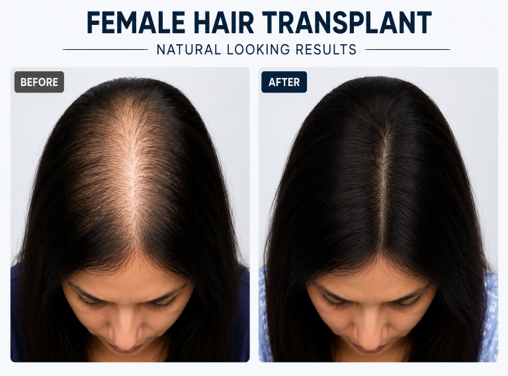
Modern techniques focus on angle, direction, density distribution, and facial harmony. Properly performed procedures can look extremely natural.
This is false. Hair transplant for women in India is increasingly common, especially among women experiencing pattern thinning or traction-related hair loss.
The procedure is typically performed under local anesthesia, and discomfort is generally manageable.
Hair restoration is gradual. Natural growth takes time. Most transplanted follicles begin shedding initially after surgery. Permanent regrowth typically begins after around 3–4 months.
Not all women need surgery immediately. Many women benefit from non-surgical female hair loss treatment options instead.
Hair loss in women is medically complex and emotionally exhausting because it often progresses slowly while silently affecting confidence over time.
The encouraging reality is that modern hair transplant for women in India procedures are now safer, more technically advanced, and far more natural-looking than before. A properly planned female hair transplant can significantly improve density, scalp coverage, hairline structure, and overall confidence.
At Eternelle Aesthetics, we focus on combining scientific diagnosis, regenerative support, and individualized restoration strategies to create safe, natural, and medically guided outcomes for women experiencing persistent hair thinning.
If you are experiencing persistent thinning, widening partitions, or visible scalp exposure, schedule a personalized consultation with us to understand the root cause of your hair loss and explore the most suitable treatment options for you.
Ready to understand your hair loss better?
At Eternelle Aesthetics, Hyderabad, we begin with a thorough scalp and hormonal evaluation before recommending any treatment — surgical or non-surgical. No guesswork, no unnecessary procedures.
Schedule a Consultation →Medically reviewed by Dr. Maalavika Appasani and Dr. Deepthi Devarakonda, Eternelle Aesthetics, Hyderabad.
Women with PCOS may undergo hair transplantation if hormonal imbalance is medically controlled and donor hair remains stable. Proper evaluation is necessary before planning the procedure.
Transplanted hair behaves like natural hair after growth begins. Patients can usually wash, oil, cut, and style it normally once healing is complete.
Yes, hair transplantation can improve density around widening partitions and frontal thinning areas when enough healthy donor follicles are available for implantation.
There is no fixed age, but specialists usually recommend waiting until hair loss patterns become stable and underlying medical causes are properly evaluated and managed.
Yes, PRP and GFC therapy are often combined with hair transplantation to support healing, improve scalp health, and enhance the growth environment for transplanted follicles.