
Date 18 Mar 2026
Men in India typically lose hair due to androgenetic (hormone-driven) balding, while women more often face diffuse thinning linked to hormones, nutrition, and stress. Because the biology and patterns differ, Hair loss treatment for men and women must be personalised using a combination of medical therapy, in‑clinic procedures, and lifestyle correction.
Hair loss is increasingly common among both men and women in India. What was once considered a problem of ageing is now seen frequently in younger adults, especially in urban areas where lifestyle stress, irregular sleep, and dietary imbalances are common.
Although both genders experience hair fall, the patterns often differ. Women usually notice overall thinning or increased shedding across the scalp, while men more commonly develop a receding hairline or thinning at the crown. Because these patterns vary, hair loss in men vs women often appears different even when some triggers are shared.
Not sure which type of hair loss you’re experiencing? Consult a hair specialist for a personalised diagnosis.
Urban lifestyle factors significantly contribute to male vs female hair loss. Stressful work schedules, irregular sleep, pollution, and nutritional gaps can weaken hair follicles and trigger excessive shedding.
Recognizing these early signs is important because hair loss treatment for men and women works best when started early, before significant follicle damage occurs.
Read More: Hair Fall vs Hair Loss: How to Identify the Stage & Act Early
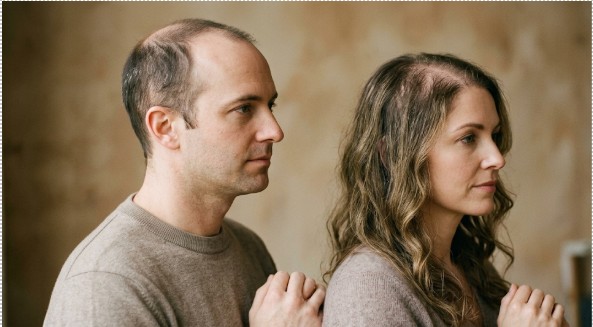
Although stress, diet, and medical conditions can affect both genders, the pattern and hormonal drivers behind hair loss in men vs women are distinct.
Experiencing early hair thinning? Book a scalp assessment to identify the root cause.
Most men experiencing hair loss are affected by androgenetic alopecia (AGA), commonly called male pattern baldness.
This condition occurs because certain hair follicles are genetically sensitive to dihydrotestosterone (DHT), a hormone derived from testosterone. Over time, DHT causes the hair follicles to shrink, producing thinner and weaker hair strands.
Typical signs include:
Gradual recession of the hairline and temples
Thinning at the crown of the scalp
An “M-shaped” hairline pattern
Progressive miniaturisation of hair follicles
Indian clinical studies show that many men begin noticing early Norwood stage balding in their 20s or early 30s, which gradually progresses if left untreated. Early intervention is therefore essential.
Seeing early signs of receding hairline? Explore treatment options for male pattern baldness.
Female hair loss rarely follows the same pattern as male baldness. which is why Hair loss treatment for men and women cannot be identical. Female pattern hair loss (FPHL) shows:
Instead of a receding hairline, women usually experience diffuse thinning over the central scalp and crown with preservation of the frontal hairline in many cases.
This condition is known as female pattern hair loss (FPHL) and typically shows:
Widening of the central hair part
Reduced hair density on the crown
Overall thinning without complete bald patches
Preservation of the frontal hairline
These women often have underlying triggers such as polycystic ovary syndrome (PCOS), iron deficiency, crash diets, or thyroid imbalances.
Noticing increased hair shedding or widening part? Get a hormonal and scalp evaluation.
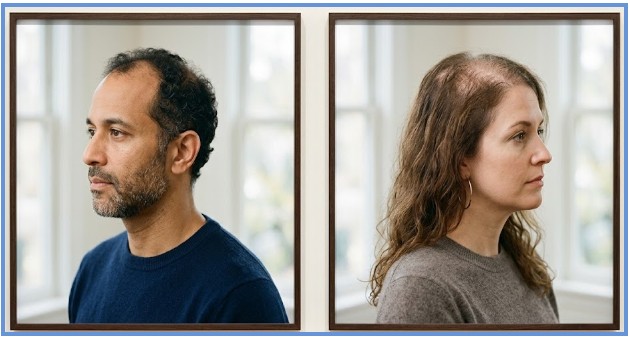
The biology behind male vs female hair loss explains why doctors cannot prescribe the same protocol to everyone.
Hormones and Genetics in Men
In men, local scalp conversion of testosterone to DHT by the enzyme 5‑alpha‑reductase is central to AGA. Studies show that affected hair follicles have increased androgen receptor activity and higher local DHT, even if blood hormone levels are “normal”.
An Indian study on premature AGA in men under 30 found altered levels of androgens and sex hormone‑binding globulin, suggesting a hormonal pattern comparable to “male PCOS”. This strengthens the case for early, hormone‑targeted treatment in suitable candidates.
Hormones, Metabolism and Life Stages in Women
In women, estrogen, progesterone and androgens all play a role in hair cycling. FPHL often worsens during:
Post‑partum period (after delivery).
Perimenopause and menopause.
Periods of uncontrolled PCOS, insulin resistance or obesity.
Indian data show that many women with hair loss have coexisting issues like anaemia, vitamin D deficiency, thyroid disorders, or chronic stress, all of which must be corrected along with scalp‑focused treatment. This is a major reason hair loss treatment for men and women requires different investigations and blood work‑ups before finalising a plan.
Why Hair Hoss Treatments Differ Between Men and Women
Because the biological drivers vary, dermatologists cannot prescribe identical treatments for everyone.
Two of the most widely used evidence-based drugs for androgenetic alopecia are minoxidil and finasteride, but their usage differs between genders.
Minoxidil
Stimulates hair follicles and prolongs the growth phase
Approved for both men and women
Typically used as 5% solution for men and 2–5% solution for women
Finasteride
Blocks the enzyme responsible for converting testosterone to DHT
Commonly prescribed to men with male pattern baldness
For women, doctors often focus more on topical therapy, nutritional correction, and hormonal evaluation. This is why hair loss treatment for men and women must be carefully individualised.
Modern aesthetic clinics in Hyderabad and across India increasingly rely on combination treatments rather than a single modality for male vs female hair loss. Common procedures include:
1.) Platelet-Rich Plasma (PRP)
PRP involves extracting a patient’s blood, concentrating the platelets, and injecting them into thinning scalp areas. Platelets contain growth factors that stimulate hair follicles and improve scalp health.
Clinical experience suggests that PRP combined with medical therapy can improve hair density significantly, sometimes showing 15–17% better outcomes compared with medication alone.
2.) Growth Factor Concentrate (GFC)
GFC is an advanced regenerative therapy derived from the patient’s own blood. It isolates highly concentrated growth factors that are injected into the scalp to stimulate hair follicles, improve circulation, and strengthen hair roots.
GFC is commonly used for early hair thinning and supports personalised hair loss treatment for men and women.
Read More: GFC vs PRP Hair Treatment: Which One Works Better for Hair Regrowth
3.) Mesotherapy
Mesotherapy involves injecting vitamins, peptides, and amino acids into the scalp to nourish hair follicles and improve circulation. It is often used as a supportive therapy in both men and women experiencing thinning hair.
4.) Low-Level Laser Therapy (LLLT)
LLLT uses controlled wavelengths of red or near-infrared light to reduce scalp inflammation and stimulate follicular activity. It is considered safe for both genders and is particularly helpful for diffuse hair thinning.
While these technologies are used for both sexes, the treatment protocols differ based on the pattern of hair loss.
Hair transplantation is one of the most effective solutions for advanced male pattern baldness.
The procedure works best when:
The donor area at the back of the scalp is dense
Hair loss has stabilised with medical therapy
Bald areas are clearly defined
In women, transplantation is used more selectively because female hair loss is usually diffuse rather than patch-based. Many women respond better to regenerative therapies and medical treatment instead.
Read More: Is Hair Follicle Transplant Right for You?
Delaying consultation is one of the biggest reasons men and women lose transplant‑free options. Consider seeing a trichology‑focused dermatologist if you notice:
Receding hairline or widening parting line.
Increased hair on pillow, bathroom drains or comb for more than 3–4 weeks.
Visible thinning in photographs or when tying hair back.
Evidence shows that early intervention in androgenetic alopecia slows progression significantly, improves density, and may reduce the need for extensive transplant surgeries later.
Considering a permanent solution? Book a hair transplant consultation.
Hair loss can affect confidence and emotional well-being, but understanding the science behind hair loss in men vs women helps patients make informed decisions about treatment.
Men typically experience hormone-driven baldness, while women often face diffuse thinning influenced by hormonal, metabolic, and lifestyle factors. Because these causes differ, hair loss treatment for men and women must be carefully personalised.
At advanced aesthetic clinics like Eternelle Aesthetics in Hyderabad, patients benefit from a combination of medical expertise, diagnostic evaluation, and modern regenerative therapies designed to address both male vs female hair loss effectively.
With early diagnosis and the right treatment plan, many people can slow hair loss, strengthen follicles, and restore healthier hair growth.
Speak with our experts to understand the right treatment for you. Contact us.
No, many anti‑hair loss tablets prescribed for men, especially finasteride and dutasteride, are not routinely recommended for women of child‑bearing age because of potential risks to a male foetus. Women usually rely on topical treatments, nutritional correction, and carefully selected hormonal therapy under specialist supervision.
Most patients begin to notice reduced shedding and early thickening after 3–4 PRP sessions spaced 4–6 weeks apart, with optimal improvement around 6–9 months. Maintenance sessions every few months help sustain results, especially in ongoing androgenetic alopecia.
In early‑stage male pattern baldness, a combination of topical minoxidil, oral finasteride, lifestyle correction, and PRP can stabilise or partially reverse thinning in many men. Once follicles have completely miniaturised and the scalp is shiny and smooth, transplant becomes the main option for visible coverage.
Both men and women with untreated thyroid disorders can develop diffuse hair thinning and increased shedding. However, because women experience thyroid disease more often, they tend to present with mixed patterns-FPHL plus diffuse shedding, which requires more detailed blood work and tailored treatment.
Natural oils, gentle massage and basic dietary changes may improve scalp health but are rarely sufficient for chronic androgenetic alopecia or long‑standing FPHL. Evidence‑based medical therapy and in‑clinic treatments are usually necessary for meaningful regrowth and density improvement.